
Article Summary
Kidwelly Castle is one of the finest and most complete medieval fortresses in Wales, dominating the landscape above the River Gwendraeth in Carmarthenshire. Built over three centuries from Norman times through to the late medieval period, the castle represents a masterpiece of military architecture that withstood sieges, witnessed rebellions, and played a crucial role in the turbulent history of south Wales. This guide covers the castle’s fascinating history, its impressive architectural features, and practical information for planning your visit to this remarkable Welsh stronghold.
A Fortress Above the River
Kidwelly Castle rises from a ridge overlooking the River Gwendraeth, its massive walls and towers commanding the landscape as they have for over 800 years. This is one of the great medieval fortresses of Wales—a castle that evolved through centuries of conflict, each generation adding new defences until the result was a stronghold of formidable power and sophistication.
Unlike the famous Edwardian castles of north Wales, built in a single campaign of conquest, Kidwelly grew organically over time. Norman earthworks gave way to stone fortifications; a simple enclosure became a concentric fortress with walls within walls; domestic buildings were added, improved, and rebuilt as the castle served successive lords through peace and war. The result is a layered monument to medieval military architecture, each phase of construction visible to those who know where to look.
Today, Kidwelly Castle stands in remarkable condition. The outer walls survive largely intact, the great gatehouse dominates the approach, and the towers that punctuate the defences retain much of their original height. Visitors can explore passages, climb towers, and walk the wall-walks that once provided defenders with commanding fields of fire. Few Welsh castles offer such a complete and atmospheric medieval experience.
The town of Kidwelly itself, huddled beside the castle, retains much of its medieval character. Narrow streets wind between historic buildings, and the parish church—founded at the same time as the castle—stands as a reminder of the religious dimension of Norman colonisation. Together, the castle and town provide a window into the medieval Welsh experience that rewards exploration and reflection.
The Norman Foundation
The story of Kidwelly Castle begins in the years following the Norman Conquest of England, when adventurous lords pushed westward into Wales seeking land, wealth, and power. The Normans did not conquer Wales in a single campaign as they had England; instead, individual lords carved out territories in a piecemeal process that took generations and was never entirely complete.
Roger, Bishop of Salisbury
The first castle at Kidwelly was established around 1106 by Roger, Bishop of Salisbury, one of the most powerful men in Norman England. Roger served as chief minister to King Henry I, effectively governing England during the king’s frequent absences in Normandy. His construction of a castle at Kidwelly reflected both personal ambition and royal policy—extending Norman control into the rich lands of south Wales.
The original castle was an earthwork fortification, a ringwork consisting of a raised platform surrounded by a ditch and topped with a timber palisade. This type of fortification could be constructed quickly using local labour, establishing a defensible position from which the Normans could dominate the surrounding territory.
The site was well chosen. The ridge provided natural elevation, the river protected one flank, and the position commanded the crossing point and the fertile lowlands of the Gwendraeth valley. From here, the Normans could control movement, extract tribute, and project power into the Welsh interior.
The Chaworth Lords
Following Roger’s death and the political upheavals of King Stephen’s reign, Kidwelly passed through various hands before coming to the de Chaworth family in the late twelfth century. The de Chaworths would hold the lordship for over a century, transforming the earthwork castle into a stone fortress of considerable strength.
Patrick de Chaworth began the construction of stone walls around the inner ward in the late twelfth century, replacing the timber defences with masonry that could resist fire and provide more permanent protection. This work continued under his descendants, who added towers and improved the domestic accommodation within the castle.
The de Chaworth period saw Kidwelly develop from a simple stronghold into a lordly residence capable of supporting the administrative and domestic needs of a major landowner. The castle served not just as a military installation but as the centre of a lordship, housing courts, collecting revenues, and projecting the authority of its lords across their Welsh territories.
Welsh Resistance and the Lord Rhys
The Normans did not hold Kidwelly unchallenged. Throughout the twelfth and thirteenth centuries, Welsh princes contested Norman control of south Wales, and Kidwelly featured in this prolonged struggle.
The Lord Rhys
The most significant Welsh figure associated with Kidwelly was Rhys ap Gruffudd, known as the Lord Rhys (Yr Arglwydd Rhys), who dominated south Wales in the late twelfth century. Rhys was a skilled politician and warrior who played the Norman lords and the English crown against each other while extending his own power.
In 1159, Rhys captured Kidwelly Castle, demonstrating that even substantial Norman fortifications could fall to determined Welsh assault. He held the castle until 1160, when it was retaken by the Normans. This pattern of capture and recapture characterised the medieval Welsh experience—neither side able to achieve permanent dominance, the frontier shifting with the fortunes of war.
The Lord Rhys eventually reached accommodation with the English crown, and his later career saw him as a major patron of Welsh culture, hosting the famous eisteddfod at Cardigan in 1176. But his earlier attacks on Norman strongholds like Kidwelly demonstrated the vulnerability of the colonial enterprise and the continuing vitality of Welsh resistance.
Llywelyn the Great
The thirteenth century brought renewed conflict as Llywelyn ab Iorwerth, known as Llywelyn the Great, sought to unite Wales under his leadership. Llywelyn’s campaigns affected the whole of Wales, and Kidwelly did not escape the turbulence.
In 1231, Llywelyn attacked and burned Kidwelly, destroying much of the town and damaging the castle. This attack formed part of a broader campaign against the Norman lords of south Wales, demonstrating that even substantial stone fortifications could not guarantee security against a determined enemy.
The damage inflicted by Llywelyn prompted extensive rebuilding, and much of the castle visible today dates from the decades following this attack. The de Chaworths and their successors invested heavily in upgrading the defences, determined to prevent any repetition of the 1231 disaster.
The Concentric Castle
The transformation of Kidwelly into a concentric fortress—with an inner ward surrounded by an outer ward, walls within walls—represents the most significant phase of the castle’s architectural development. This work, carried out primarily in the late thirteenth and early fourteenth centuries, produced the impressive structure that survives today.
Concentric Design
The concentric castle represented the cutting edge of medieval military architecture. The principle was simple but effective: if attackers breached the outer walls, they would find themselves in a confined space overlooked by the higher inner walls, subject to attack from defenders who retained the advantage of elevation and protected positions.
At Kidwelly, the inner ward—the original Norman enclosure, now rebuilt in stone—was surrounded by a lower outer ward with its own walls and towers. The outer walls followed the contours of the ridge, creating an irregular shape that made the best use of the natural terrain. Towers at intervals along the walls provided flanking fire, allowing defenders to shoot along the wall faces at attackers attempting to scale or undermine them.
The result was a fortress of formidable strength. An attacker would need to cross the outer ditch, breach the outer wall, fight through the outer ward, cross another ditch, breach the inner wall, and overcome the defenders of the inner ward—all while under constant fire from towers and wall-walks at multiple levels.
The Great Gatehouse
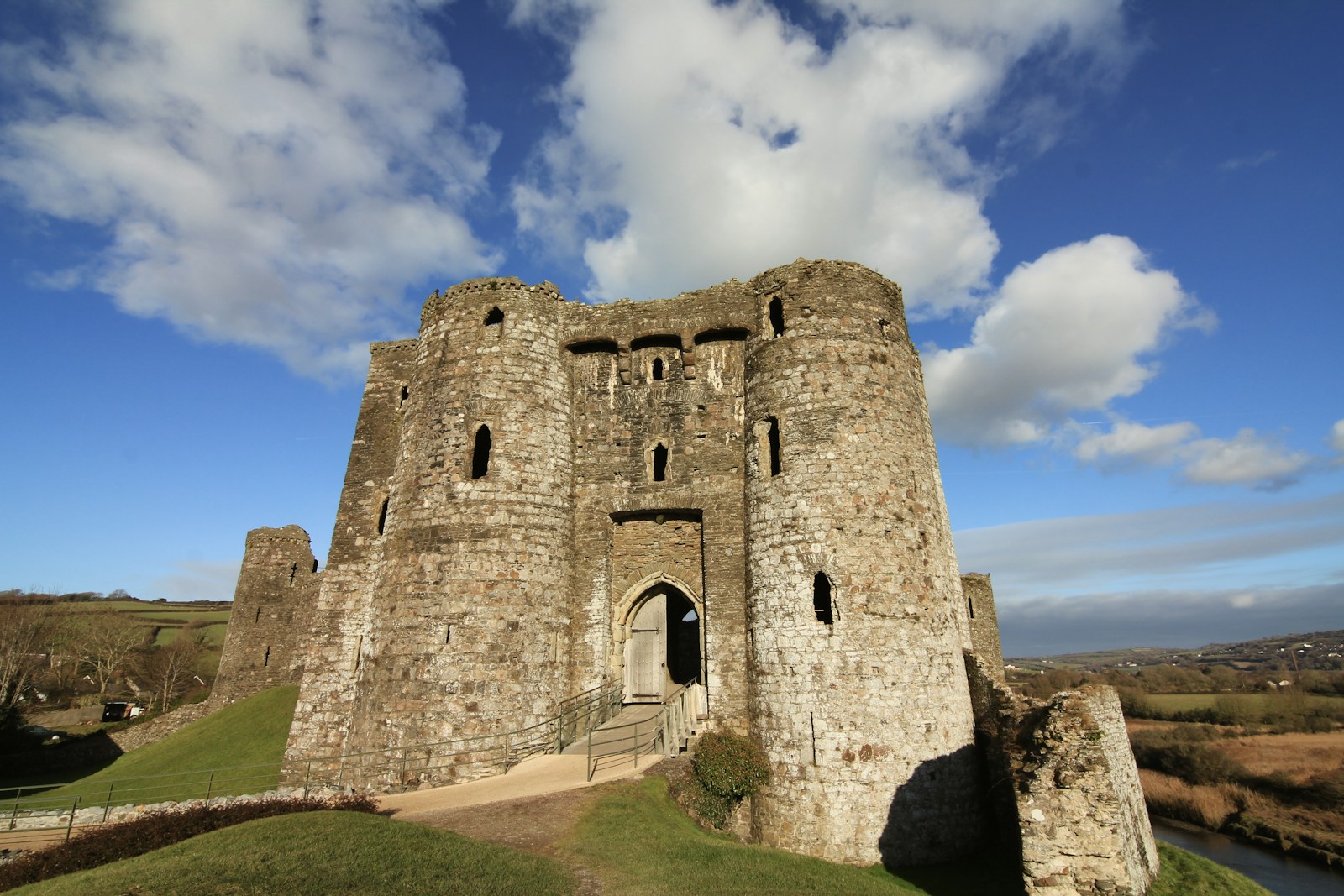
The most impressive element of Kidwelly’s concentric defences is the great gatehouse, which dominates the southern approach to the castle. This massive structure, built in the late thirteenth and early fourteenth centuries, represents medieval military architecture at its most sophisticated.
The gatehouse consists of two large D-shaped towers flanking a central passage, with residential accommodation above and defensive features throughout. The entrance passage was protected by multiple barriers: a drawbridge over the outer ditch, a portcullis, heavy timber doors, murder holes in the ceiling through which missiles could be dropped on attackers, and another portcullis and doors at the inner end.
The towers contained guardrooms, storage chambers, and residential apartments, allowing the gatehouse to function as a self-contained defensive unit. Even if attackers breached the outer wards, the gatehouse could be held independently, its defenders secure behind multiple layers of protection.
The upper floors of the gatehouse provided comfortable accommodation for the castle’s constable or for visiting lords. Large windows (on the protected inner side) admitted light to chambers that balanced defensive requirements with domestic comfort. The gatehouse thus combined the functions of fortress and residence in a single impressive structure.
The Chapel Tower
The northeast tower of the inner ward, known as the Chapel Tower, demonstrates how medieval castles combined sacred and military functions. The upper floor of this tower contained a chapel where the castle’s garrison and household could worship, its altar positioned in the curved end of the tower and lit by windows that admitted light while maintaining defensive integrity.
The chapel would have been fitted with all the necessary furnishings for religious observance—altar, images, vestments, and vessels for the mass. A chaplain attached to the castle would have celebrated daily services and ministered to the spiritual needs of the community. Religion and warfare were not separate spheres in medieval thinking, and the presence of a chapel within the castle defences reflected the integrated worldview of the age.
The Duchy of Lancaster
In 1298, Kidwelly passed to the crown when Patrick de Chaworth died without male heirs. His daughter Maud married Henry, Earl of Lancaster, and through this marriage Kidwelly became part of the vast Lancaster inheritance that would eventually be absorbed into the crown estates as the Duchy of Lancaster.
Royal Ownership
The transfer to Lancaster ownership brought new resources for castle improvement. The Lancasters were among the wealthiest and most powerful magnates in England, and they invested in their Welsh properties as part of a broader strategy of consolidating and exploiting their estates.
Much of the outer ward construction dates from this period, as does significant work on the great gatehouse. The Lancasters also improved the domestic buildings within the castle, ensuring that Kidwelly could serve as a comfortable residence for visiting lords and their retinues.
When Henry Bolingbroke, Duke of Lancaster, seized the throne as Henry IV in 1399, the Lancaster estates merged with the crown lands. Kidwelly became crown property but was administered as part of the Duchy of Lancaster, a distinction that persists to this day—the castle remains technically part of the Duchy estates, though it is managed by Cadw, the Welsh Government’s historic environment service.
The Great Hall
The inner ward contains the remains of the castle’s domestic buildings, including the great hall where the lord and his household would have dined and conducted business. The hall range runs along the north side of the inner ward, with a solar (private chamber) at one end and service rooms at the other.
The great hall was the social heart of the medieval castle. Here the lord would feast with his retinue, receive guests, dispense justice, and conduct the business of his lordship. The hall would have been furnished with a high table on a raised dais for the lord and his principal guests, with lower tables for the rest of the household arranged down the length of the room.
Large windows in the north wall admitted light while the castle’s elevated position ensured they posed minimal defensive risk. A central hearth provided warmth, the smoke rising to escape through vents in the roof. The walls would have been plastered and painted, perhaps hung with tapestries, creating an environment of appropriate grandeur for lordly hospitality.
Owain Glyndŵr and Later History
The fifteenth century brought renewed conflict to Wales with the rebellion of Owain Glyndŵr, and Kidwelly once again found itself on the front line of Welsh resistance to English rule.
The Glyndŵr Rebellion
Owain Glyndŵr’s rebellion, which erupted in 1400, was the last and greatest Welsh uprising against English rule. At its height, Glyndŵr controlled most of Wales and had established the apparatus of an independent Welsh state. Kidwelly, as a royal castle in south Wales, became a target for the rebels.
In 1403, Glyndŵr’s forces attacked Kidwelly, besieging the castle and burning the town. The castle held out—its concentric defences proving their worth—but the surrounding area suffered severely. The garrison endured a difficult siege before relief arrived, demonstrating both the strength of the fortifications and the determination of Glyndŵr’s followers.
The rebellion gradually collapsed after 1410, though Glyndŵr himself was never captured. Kidwelly survived the uprising intact, but the experience reinforced the importance of maintaining strong defences even in supposedly peaceful times.
Decline and Decay
The fifteenth and sixteenth centuries saw Kidwelly’s military importance decline. The end of the Glyndŵr rebellion and the increasing stability of Tudor Wales reduced the need for powerful fortifications. The castle continued to function as an administrative centre for the lordship, but investment in maintenance diminished.
By the seventeenth century, Kidwelly was largely ruinous. The Civil War, which brought destruction to many Welsh castles, seems to have passed Kidwelly by—the castle was apparently too decayed to be worth garrisoning or slighting. Instead, it mouldered quietly, its stones gradually being robbed for other buildings, its towers open to the sky.
Preservation and Conservation
The romantic movement of the eighteenth and nineteenth centuries brought new appreciation for medieval ruins, and Kidwelly attracted artists and tourists drawn by its picturesque decay. The castle’s dramatic silhouette, rising above the river and town, featured in numerous paintings and engravings that spread its fame beyond Wales.
Formal conservation began in the twentieth century, with the castle passing into state guardianship and receiving systematic repair and stabilisation. Today, Kidwelly is managed by Cadw and is one of the best-preserved medieval castles in Wales, its walls and towers maintained to allow visitors to experience the full impact of this remarkable fortress.
Exploring the Castle Today
Kidwelly Castle offers visitors an exceptionally complete medieval fortress experience. The survival of both inner and outer walls, the great gatehouse, and substantial portions of the domestic buildings allows exploration of the castle’s military and residential functions.
The Outer Ward
Visitors enter through the outer gatehouse on the south side, immediately experiencing the scale and strength of the medieval defences. The outer ward, the space between the outer and inner walls, would have contained various service buildings, stables, and workshops serving the castle community.
Walking the outer wall circuit provides views across the surrounding landscape and demonstrates how the castle’s builders exploited the natural terrain. The towers that punctuate the walls offered defensive positions covering every angle of approach, while the wall-walk allowed rapid movement of defenders to threatened points.
The Great Gatehouse
The great gatehouse dominates any visit to Kidwelly. This massive structure can be explored in detail, from the entrance passage with its defensive features to the residential chambers above. The views from the upper floors extend across the town, the river, and the surrounding countryside, demonstrating why this position was chosen for a fortress.
The gatehouse provides the most complete surviving example of medieval domestic accommodation at Kidwelly. The chambers retain fireplaces, window seats, and other features that speak to the comfort expected by medieval lords, while the thickness of the walls and the defensive arrangements remind visitors of the building’s primary military purpose.
The Inner Ward
The inner ward, the original Norman enclosure, contains the domestic heart of the castle. The remains of the great hall, solar, kitchen, and other buildings line the walls, their functions interpretable from surviving features and archaeological evidence.
The Chapel Tower in the northeast corner retains evidence of its sacred function, while other towers served residential and defensive purposes. The well, essential for any fortress expecting siege, survives in the ward, a reminder of the practical requirements of castle life.
Wall-Walks and Towers
One of Kidwelly’s great attractions is the extent to which visitors can explore the castle’s vertical dimension. Stairs within the towers provide access to wall-walks that circuit both inner and outer defences, offering elevated perspectives on the castle’s layout and the surrounding landscape.
The towers themselves reward exploration, their multiple floors connected by spiral stairs and their chambers revealing different functions—guardrooms, storage, residential accommodation. The experience of climbing through a medieval tower, emerging onto the wall-walk with views across the Welsh countryside, brings the castle’s history to life in ways that ground-level exploration cannot match.
The Castle in Film
Kidwelly Castle has appeared in various film and television productions, its authentic medieval appearance making it a popular location for period dramas.
Monty Python and the Holy Grail
The castle’s most famous screen appearance came in Monty Python and the Holy Grail (1975), where it featured as the castle from which French soldiers taunt King Arthur and his knights. The scene, in which the French hurl insults and livestock at the English knights, has become one of the most quoted in comedy film history.
The castle’s appearance in Monty Python has brought it to the attention of audiences worldwide, and many visitors come specifically to see the location of this famous scene. The castle’s authentic medieval character made it an ideal setting for the film’s send-up of Arthurian legend, even if the comedy somewhat undermines any attempt at historical solemnity.
Other Productions
Kidwelly has featured in various other productions, its walls and towers providing an authentic backdrop for period dramas. The castle’s relatively unspoiled appearance—free from modern intrusions visible from key angles—makes it attractive to filmmakers seeking genuine medieval atmosphere.
The Town of Kidwelly
The castle cannot be fully understood without reference to the town that grew up beneath its walls. Kidwelly town was established alongside the castle as part of the Norman colonisation of south Wales, and the two have been linked throughout their history.
The Planted Town
Like many Welsh towns, Kidwelly was a deliberate creation—a planted borough established to provide a commercial and administrative centre for the Norman lordship. The town received a charter granting market rights and other privileges, attracting settlers who would pay rents and provide services to the castle.
The medieval town was defended by walls, portions of which survive, and was centred on the market place where traders gathered. The street pattern of modern Kidwelly still reflects this medieval layout, with narrow lanes and burgage plots (the long narrow properties typical of medieval towns) visible in the urban fabric.
St Mary’s Church
The parish church of St Mary stands near the castle, its tower visible alongside the castle’s silhouette in views across the town. The church was founded in the medieval period—tradition associates it with the same Bishop Roger who established the castle—and contains features from various phases of construction and reconstruction.
The church served the religious needs of both castle and town, its clergy ministering to Norman lords and Welsh peasants alike. The building has been modified over the centuries but retains medieval fabric and provides a complement to the castle for visitors interested in Kidwelly’s medieval heritage.
The Quay and River
Kidwelly’s position on the River Gwendraeth gave it access to maritime trade, and a quay below the castle served vessels carrying goods to and from the town. The river was navigable to this point, allowing coastal ships to reach the town directly.
The quay area retains some historic character, though the river’s importance for trade has long since passed. Walks along the river provide attractive views back to the castle, demonstrating the relationship between fortress, town, and waterway that shaped Kidwelly’s development.
Practical Information for Visitors
Getting to Kidwelly Castle
By car: Kidwelly lies just off the A484 between Llanelli and Carmarthen. From the M4, leave at junction 48 and follow signs for Carmarthen on the A48, then take the A484 towards Kidwelly. The castle is well signposted within the town. Sat nav postcode: SA17 5BQ.
By train: Kidwelly has a railway station on the West Wales line between Swansea and Carmarthen. The station is approximately half a mile from the castle, an easy walk through the town. Services run several times daily, making car-free visits feasible.
By bus: Bus services connect Kidwelly with Llanelli, Carmarthen, and other towns in the area. Services are less frequent than trains, so check timetables when planning your visit.
Opening Times
Kidwelly Castle is managed by Cadw and is open year-round, though hours vary by season:
Summer (March to October): Daily, typically 9:30am to 5:00pm or 6:00pm Winter (November to February): Daily, typically 10:00am to 4:00pm
Opening times may vary, so check the Cadw website for current information before visiting. The castle may close early on Christmas Eve and remains closed on Christmas Day, Boxing Day, and New Year’s Day.
Admission
Admission fees apply, with discounts for children, seniors, and families. Cadw members enjoy free entry. Current prices are available on the Cadw website.
Parking
A car park adjacent to the castle provides convenient parking for visitors. Parking is free for castle visitors. The car park can fill during busy periods, particularly on sunny weekends and during school holidays.
Facilities
Visitor facilities: A small exhibition area provides information about the castle’s history. Interpretation panels throughout the site explain features and historical events.
Toilets: Available at the castle entrance.
Shop: A small shop sells guidebooks, souvenirs, and Welsh products.
Refreshments: No café at the castle, but the town of Kidwelly offers pubs, cafés, and shops within walking distance.
Accessibility
Kidwelly Castle presents accessibility challenges due to its medieval construction:
Ground level: The outer ward and some areas of the inner ward are accessible on relatively level ground, though surfaces are uneven.
Upper levels: Access to wall-walks, towers, and upper floors involves steep stairs that are not suitable for wheelchair users or those with mobility difficulties.
Steps and uneven surfaces: Throughout the castle, visitors will encounter steps, uneven stone floors, and narrow passages. Sturdy footwear is recommended.
Cadw provides accessibility information on its website, and staff at the castle can advise on accessible routes and facilities.
How Long to Allow
A thorough visit to Kidwelly Castle takes approximately 1.5 to 2 hours, allowing time to explore the outer and inner wards, climb the towers, walk the wall-walks, and absorb the atmosphere. Those with particular interest in medieval history and architecture may wish to allow longer.
A visit can be combined with exploration of the town, including St Mary’s Church and the historic streets, extending the total time to half a day.
Best Time to Visit
Spring and autumn: Pleasant weather, smaller crowds, and atmospheric conditions make these ideal seasons for visiting. The castle’s stonework photographs well in soft light.
Summer: Longest opening hours and warmest weather, but also the busiest period. Early morning or late afternoon visits may avoid the largest crowds.
Winter: The castle is open year-round and can be atmospheric in winter conditions. Shorter days mean less time for exploration, but the castle is rarely crowded.
Nearby Attractions
Kidwelly Castle’s location in Carmarthenshire provides access to numerous other attractions in this historic corner of Wales.
Pembrey Country Park
Pembrey Country Park, approximately 5 miles south of Kidwelly, offers extensive sandy beaches, woodland walks, a dry ski slope, and various outdoor activities. The park provides a contrast to the castle visit and suits families seeking beach time alongside their historical exploration.
Carmarthen
The county town of Carmarthen, approximately 10 miles east of Kidwelly, offers additional historic interest including castle remains, the Carmarthenshire County Museum, and a traditional market town atmosphere. Carmarthen claims to be the oldest town in Wales, with Roman origins predating the Norman castle.
National Wetland Centre Wales
The Wildfowl and Wetlands Trust’s National Wetland Centre at Llanelli, approximately 8 miles from Kidwelly, provides wildlife watching opportunities including flamingos, swans, and numerous wetland bird species. The centre suits families and nature enthusiasts.
Carreg Cennen Castle
Carreg Cennen Castle, approximately 20 miles northeast of Kidwelly, occupies one of the most dramatic positions of any castle in Wales, perched on a limestone crag above the Carmarthenshire countryside. This native Welsh fortress provides an interesting contrast to Norman Kidwelly.
Dylan Thomas Boathouse
The Dylan Thomas Boathouse at Laugharne, approximately 15 miles west of Kidwelly, preserves the home where the poet wrote many of his most famous works including Under Milk Wood. The boathouse, writing shed, and town offer literary pilgrimage combined with coastal scenery.
Frequently Asked Questions About Kidwelly Castle
Where is Kidwelly Castle located?
Kidwelly Castle is located in the town of Kidwelly in Carmarthenshire, south Wales. It lies just off the A484 between Llanelli (approximately 7 miles west) and Carmarthen (approximately 10 miles east).
How old is Kidwelly Castle?
The first castle at Kidwelly was established around 1106, making the site over 900 years old. The stone castle visible today was built primarily between the late twelfth and early fourteenth centuries.
Who built Kidwelly Castle?
The original earthwork castle was built by Roger, Bishop of Salisbury, around 1106. The stone castle was developed by the de Chaworth family and later by the Earls of Lancaster, who created the concentric fortress visible today.
Is Kidwelly Castle in Monty Python?
Yes, Kidwelly Castle featured in Monty Python and the Holy Grail (1975), appearing as the castle where French soldiers taunt King Arthur with insults and catapulted farm animals. The scene is one of the most famous in comedy film history.
Is Kidwelly Castle worth visiting?
Kidwelly Castle is one of the finest and most complete medieval castles in Wales, offering extensive exploration opportunities including wall-walks, towers, and a great gatehouse. It is highly recommended for anyone interested in medieval history and architecture.
How long does it take to visit Kidwelly Castle?
A thorough visit takes approximately 1.5 to 2 hours, allowing time to explore all areas of the castle including the towers and wall-walks. Those with particular interest in medieval castles may wish to allow longer.
Is Kidwelly Castle free to visit?
No, admission fees apply. The castle is managed by Cadw, and current prices are available on their website. Cadw members enjoy free entry.
Can you walk on the walls at Kidwelly Castle?
Yes, wall-walks are accessible at both inner and outer ward levels, offering elevated views and the experience of medieval defensive positions. Access involves climbing stairs within the towers.
Is Kidwelly Castle accessible for wheelchairs?
The castle presents significant accessibility challenges due to its medieval construction. Ground-level areas are partially accessible, but upper levels, towers, and wall-walks involve steep stairs not suitable for wheelchairs.
Does Kidwelly have a train station?
Yes, Kidwelly has a railway station on the West Wales line between Swansea and Carmarthen, approximately half a mile from the castle. Services run several times daily.
What is a concentric castle?
A concentric castle has two or more rings of defensive walls, with each inner wall higher than the outer. This design meant attackers who breached the outer wall faced further defences while being overlooked from above. Kidwelly is an excellent example of concentric castle design.
Was Kidwelly Castle ever attacked?
Yes, Kidwelly Castle was attacked several times throughout its history. The Lord Rhys captured it in 1159, Llywelyn the Great burned it in 1231, and Owain Glyndŵr besieged it in 1403. The castle survived all these attacks.
Who owns Kidwelly Castle?
Kidwelly Castle is part of the Duchy of Lancaster estate but is managed by Cadw, the Welsh Government’s historic environment service, which maintains and opens the castle to visitors.
Is there parking at Kidwelly Castle?
Yes, a free car park adjacent to the castle provides convenient parking for visitors.
Can you take dogs to Kidwelly Castle?
Dogs on leads are welcome at Kidwelly Castle, though the narrow stairs and uneven surfaces may make some areas challenging for dogs.
What other castles are near Kidwelly?
Nearby castles include Carreg Cennen (approximately 20 miles), Carmarthen Castle (approximately 10 miles), and Llansteffan Castle (approximately 12 miles). The castles of Pembrokeshire lie further west.
