
Article Summary
Tredegar House is a magnificent seventeenth-century mansion on the outskirts of Newport, south Wales, considered one of the finest late Stuart houses in Britain. Home to the Morgan family for over 500 years, the property showcases stunning Restoration architecture, lavish state rooms, and 90 acres of historic parkland. This guide covers the fascinating history of Tredegar House, the Morgan family who shaped it, and practical information for planning your visit to this National Trust property.
A Hidden Gem of Welsh Heritage
Tredegar House stands on the western edge of Newport, a great red-brick mansion that ranks among the most important historic houses in Wales. Yet compared to Cardiff Castle or the castles of north Wales, it remains relatively undiscovered—a hidden gem that rewards those who seek it out with one of the finest examples of Restoration architecture in Britain.
The house tells the story of the Morgan family, who lived here for more than five centuries and whose fortunes rose and fell with the tides of Welsh and British history. From medieval Welsh gentry to Civil War commanders, from Georgian grandees to Victorian eccentrics, the Morgans left their mark on this place. Today, under the care of the National Trust, Tredegar House opens its doors to visitors who can explore the state rooms, servants’ quarters, and historic parkland that together paint a vivid picture of life in a great Welsh country house.
The Medieval Origins
The Morgan family’s connection with this land stretches back to at least the early fifteenth century, though their roots in Wales run deeper still. They traced their ancestry to the medieval Welsh princes, and the name Morgan—from the Welsh Morcant—speaks to their native origins in a period when much of the Welsh gentry was being absorbed into English patterns of landholding and culture.
A medieval stone house stood on the site before the present mansion, and fragments of this earlier building survive within the current structure. The Morgans of this period were typical of the Welsh uchelwyr, the native gentry who navigated the transition from medieval Welsh lordship to incorporation within the English crown. They accumulated land, made advantageous marriages, and gradually rose in wealth and status.
By the sixteenth century, the Morgans of Tredegar had established themselves among the leading families of Monmouthshire. They held local offices, sat in Parliament, and built connections with the Tudor court. The foundations were being laid for the family’s golden age in the century that followed.
The Civil War and William Morgan
The English Civil War of the 1640s brought crisis and opportunity to families across Britain, and the Morgans were no exception. The family initially supported the Royalist cause, as did most of the Welsh gentry, but the war’s outcome would prove transformative.
William Morgan, who inherited the estate in 1653, emerged from the conflict as a man of substance and ambition. Though the Morgans had backed the losing side, William proved adept at navigating the political complexities of the Interregnum and the Restoration that followed. When Charles II returned to the throne in 1660, William Morgan was well positioned to benefit.
It was William Morgan who built the Tredegar House we see today. Beginning in the early 1660s, he commissioned a completely new mansion in the latest fashion—a confident statement in red brick that announced his family’s arrival among the elite of British society. The house took approximately a decade to complete, and its sophistication suggests the involvement of architects familiar with the most advanced developments in English country house design.
The Restoration Mansion
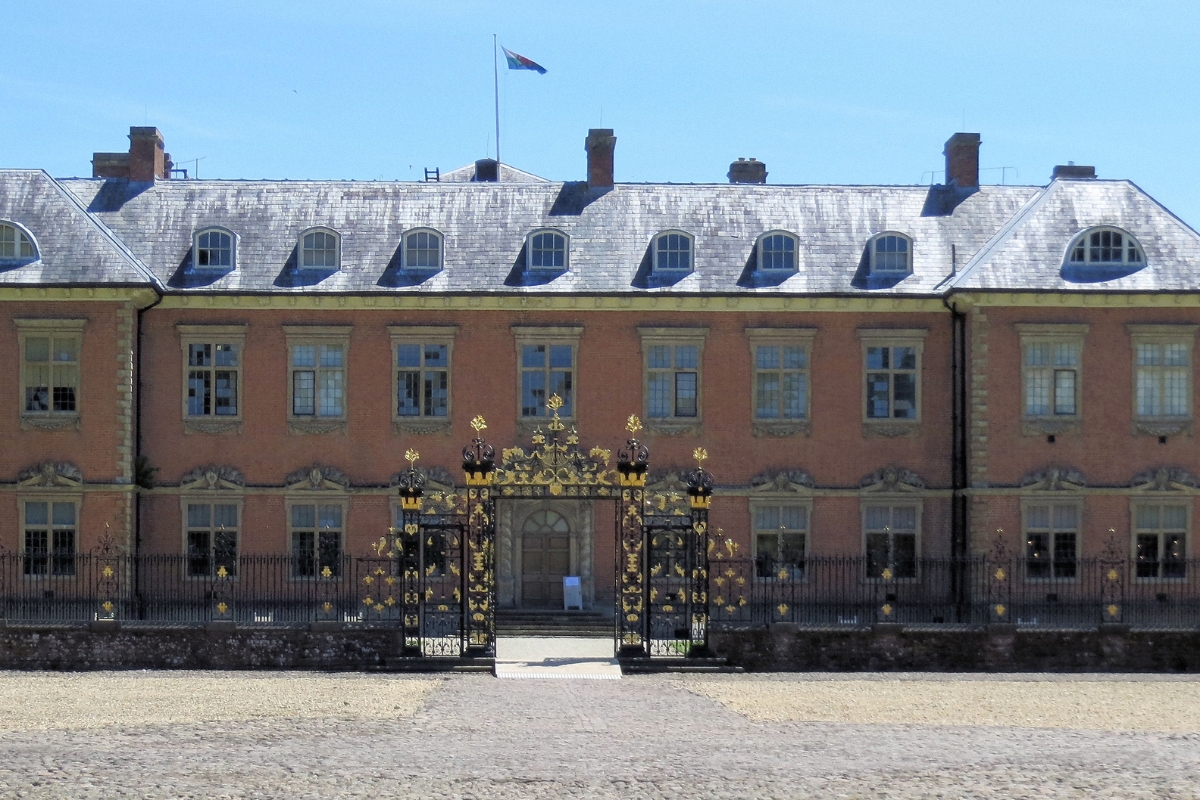
The Tredegar House that William Morgan created is a masterpiece of Restoration architecture. Built primarily of red brick with stone dressings, the house follows an H-plan layout with projecting wings flanking a central block. The style reflects the influence of Dutch and French architecture that swept through England following the Restoration, when Charles II and his courtiers brought Continental tastes back from their years of exile.
The southwest front, facing the approach drive, presents a formal façade of classical symmetry. Tall windows march in regular ranks across the brick elevation, topped by a roofline of dormers and chimneys. The effect is one of ordered elegance, a world away from the irregular medieval buildings that preceded it.
Inside, the house was fitted out with equal ambition. The state rooms on the first floor were designed for display and entertainment, their ceilings and walls decorated by skilled craftsmen in the ornate style of the period. The carved woodwork, decorative plasterwork, and gilded details that survive today speak to William Morgan’s determination to create a house fit for the highest society.
The Brown Room, with its elaborate carved panelling of American black walnut, exemplifies the quality of craftsmanship throughout the house. The Gilt Room, used for the most important social occasions, dazzles with its gilded decoration and painted ceiling. These interiors rank among the finest surviving examples of Restoration decorative arts in Britain.
The Eighteenth Century: Prosperity and Politics
The eighteenth century brought continued prosperity to the Morgans of Tredegar. The family’s estates expanded through purchase and marriage, their political influence grew, and the house was updated to reflect changing tastes.
Sir William Morgan, the third baronet, served as Member of Parliament for Monmouthshire and played a significant role in local affairs. His son, another William, continued the family’s political engagement, and Tredegar House became a centre of social and political life in south Wales.
The Georgian Morgans made alterations to their ancestral home, though they preserved much of the Restoration character that makes the house so significant today. The stable block, an impressive courtyard complex to the northeast of the house, dates from this period, as do improvements to the grounds and gardens.
The orangery, a elegant garden building designed to shelter citrus trees and other tender plants through the Welsh winter, reflects the fashionable interests of the Georgian gentry. Orangeries served as status symbols as much as practical structures, and Tredegar’s example—with its tall windows designed to admit maximum light—demonstrates the Morgans’ continued engagement with architectural fashion.
The Nineteenth Century: Victorian Tredegar
The nineteenth century transformed Tredegar and its surroundings. The industrial revolution swept through south Wales, turning the valleys to the north into one of the world’s great centres of iron and coal production. Newport, the small market town beyond the Tredegar gates, grew into a major port and industrial centre.
The Morgans benefited enormously from this transformation. Coal was discovered beneath their estates, and mineral royalties swelled the family coffers. By mid-century, the Morgans of Tredegar ranked among the wealthiest families in Wales.
Charles Morgan Robinson Morgan, who became the first Baron Tredegar in 1859, embodied Victorian prosperity and public service. He served as Lord Lieutenant of Monmouthshire and as Member of Parliament before his elevation to the peerage. At Tredegar House, he and his successors made improvements throughout the estate, updating services, redecorating interiors, and maintaining the house as a centre of aristocratic life.
The second Baron Tredegar, Godfrey Morgan, achieved fame through an accident of history. As a young officer in the 17th Lancers, he rode in the Charge of the Light Brigade at Balaclava in 1854, one of the most celebrated—and catastrophic—cavalry actions in British military history. Godfrey survived the charge, as did his horse Sir Briggs, and both became objects of considerable public interest. Sir Briggs lived out his days in honourable retirement at Tredegar, and when he died in 1874, he was buried in the grounds with a headstone that can still be seen today.
The Twentieth Century: Decline and Eccentricity
The twentieth century brought challenges that the Morgans, like many British aristocratic families, struggled to meet. Death duties, agricultural depression, changing social conditions, and the costs of maintaining a great house all took their toll.
Evan Morgan, who became the sixth and last Baron Tredegar in 1934, was among the most colourful figures in the family’s long history. A poet, occultist, and friend of artists and writers, he moved in bohemian circles far removed from the traditional world of the Welsh gentry. His interests included the Catholic Church—he converted and later hosted the Papal Nuncio at Tredegar—and the occult. He was rumoured to practise black magic, kept a menagerie of exotic animals, and hosted guests including Aleister Crowley and H.G. Wells.
Evan Morgan’s unconventional lifestyle accelerated the estate’s decline. He sold off land and assets, and Tredegar House itself fell into disrepair. When he died in 1949 without an heir, the barony became extinct and the estate passed to a distant relative who had little connection with the property.
Salvation and Restoration
The decades following Evan Morgan’s death brought Tredegar House to the brink of destruction. The house was sold in 1951 and passed through various hands, serving for a time as a school. The building deteriorated, the contents were dispersed, and the estate was fragmented.
Newport Borough Council acquired the house in 1974, recognising its significance even in its diminished state. A programme of restoration began, stabilising the structure and beginning the long process of returning the house to something approaching its former glory.
In 2012, the National Trust took over the management of Tredegar House, bringing the resources and expertise of Britain’s largest conservation charity to bear on this important property. Restoration work has continued, with projects addressing everything from the roof to the decorative plasterwork, the gardens to the stable block.
Today, Tredegar House stands as testament to what can be achieved through determined conservation. Though some losses are irrecoverable—the original contents were largely sold and scattered—the house itself survives, its architecture intact and its significance recognised.
What to See at Tredegar House
The State Rooms
The first-floor state rooms represent the heart of Tredegar House and its finest achievement. These spaces were designed for the display of wealth, taste, and social position, and they retain their power to impress more than 350 years after their creation.
The Gilt Room is the house’s showpiece, a dazzling chamber where gilded woodwork, painted panels, and elaborate plasterwork combine to overwhelming effect. This was the room where the Morgans received their most important guests, and its decoration reflects that status.
The Brown Room, panelled entirely in carved American black walnut, offers a different but equally impressive atmosphere. The quality of the carving—fruit, flowers, and foliage rendered in extraordinary detail—ranks among the finest woodwork of the period surviving anywhere in Britain.
The New Hall, the Best Chamber, and the other state rooms each contribute to the sequence of spaces through which visitors moved, each room calibrated to reflect the status of those admitted to it.
Below Stairs
Tredegar House offers an unusually complete picture of life below stairs in a great country house. The kitchen, servants’ hall, housekeeper’s room, and other service spaces survive, and the National Trust has furnished and interpreted them to bring this hidden world to life.
The kitchen, with its massive ranges and batteries of copper pans, speaks to the labour required to feed a household that might number dozens of family members, guests, and servants. The servants’ hall, where the lower servants took their meals, and the housekeeper’s room, where the senior female servant maintained her domain, illustrate the rigid hierarchies of domestic service.
These spaces offer a valuable counterpoint to the splendour of the state rooms above. The same house that dazzled guests with gilding and carving depended on an army of workers who lived and laboured in more modest surroundings.
The Stable Block
The stable block at Tredegar House is a significant architectural composition in its own right. Built around a large courtyard, it provided accommodation for the horses, carriages, and grooms that a family of the Morgans’ status required.
Today the stable block houses a café and shop, as well as interpretation displays on the history of the estate. The courtyard hosts events throughout the year, from Christmas markets to outdoor performances.
The Gardens and Parkland
Tredegar House sits within 90 acres of historic parkland, a designed landscape that evolved over centuries to provide the appropriate setting for the mansion. The formal gardens near the house, the pleasure grounds beyond, and the wider park all invite exploration.
The orangery, restored to something approaching its original condition, stands as a reminder of Georgian horticultural ambitions. The walled garden, once the productive heart of the estate, is being restored and planted. Ancient trees, some dating back to the time of the Restoration house, punctuate the parkland.
A lake, created in the eighteenth century as part of the landscape improvements, provides a focal point for walks through the grounds. The path around the lake offers views back to the house and opportunities to spot the wildlife—including herons, kingfishers, and numerous waterfowl—that has made Tredegar its home.
Sir Briggs’s Grave
The grave of Sir Briggs, the horse who carried Godfrey Morgan through the Charge of the Light Brigade, lies in the grounds near the house. The simple headstone has become one of the most visited spots at Tredegar, a poignant connection to one of the most famous events in British military history.
Why You Should Visit Tredegar House
Exceptional Restoration Architecture
Tredegar House ranks among the finest examples of Restoration architecture in Britain. The sophistication of its design, the quality of its craftsmanship, and the completeness of its survival make it a building of national importance. For anyone interested in architectural history, Tredegar is essential.
A Welsh Story Across Five Centuries
The Morgan family’s 500-year tenure at Tredegar encompasses the whole sweep of Welsh history from the medieval period to the twentieth century. Their story illuminates the experience of the Welsh gentry as Wales was transformed by union with England, by industrialisation, and by the social changes of the modern era.
The Complete Country House Experience
From the gilded state rooms to the working kitchen, from the stable courtyard to the orangery, Tredegar House offers an unusually complete picture of country house life. Visitors can understand not just how the family lived but how the house functioned as a complex social and economic organism.
Ninety Acres of Parkland
The grounds at Tredegar House provide space to breathe and explore. The combination of formal gardens, pleasure grounds, parkland, and lake offers walks for all abilities and interests, from short strolls to longer circuits. The parkland is open even when the house is closed, making Tredegar a valuable green space for local residents and visitors alike.
A Manageable Scale
Unlike some overwhelming stately homes, Tredegar House is compact enough to explore thoroughly in a single visit. The house tour takes perhaps an hour, leaving time to explore the grounds, visit the café, and absorb the atmosphere without exhaustion.
Planning Your Visit
Opening Times
Tredegar House is open to visitors throughout the year, though opening days and hours vary by season. The house is typically open Wednesday to Sunday from March to October, with more limited hours in winter. The grounds and parkland have extended hours, often opening earlier and closing later than the house itself. Check the National Trust website for current opening times before visiting.
Admission
Tredegar House is a National Trust property, and admission is free for National Trust members. Non-members pay an admission fee that includes access to the house, gardens, and grounds. The parkland is often accessible free of charge outside house opening hours.
Getting There
Tredegar House lies on the western outskirts of Newport, well signposted from the M4 motorway. The postcode for satnav is NP10 8YW. Ample free parking is available on site.
For those travelling by public transport, the nearest railway station is Newport, approximately three miles from the house. Bus services run from Newport city centre, though checking current timetables is advisable.
Facilities
The stable block houses a café serving light meals, sandwiches, cakes, and hot drinks. A National Trust shop offers books, gifts, and local products. Toilet facilities, including accessible toilets, are available.
Picnicking is welcome in the parkland, and the grounds include several spots suitable for spreading a blanket on a fine day.
Accessibility
The ground floor of Tredegar House is accessible to wheelchair users, though the first-floor state rooms are reached by stairs. A virtual tour and detailed photographs are available for those unable to access the upper floors. The grounds include accessible paths, though some areas involve uneven surfaces. Mobility scooters are available to borrow, and assistance dogs are welcome.
How Long to Allow
A thorough visit to Tredegar House, including the house tour, service areas, stable block, and a walk in the grounds, takes approximately three hours. Those wishing to explore the parkland more extensively, enjoy a leisurely lunch, or simply sit and absorb the atmosphere should allow longer.
Frequently Asked Questions About Tredegar House
Where is Tredegar House located?
Tredegar House is located on the western outskirts of Newport in south Wales, just off junction 28 of the M4 motorway. The postcode is NP10 8YW. It lies approximately 12 miles east of Cardiff and 3 miles from Newport city centre.
How old is Tredegar House?
The present Tredegar House was built in the 1660s and 1670s, making it over 350 years old. However, the Morgan family had lived on the site since at least the early fifteenth century, and fragments of earlier medieval buildings survive within the current structure.
Who lived at Tredegar House?
Tredegar House was home to the Morgan family for over 500 years, from the medieval period until 1951. The family rose from Welsh gentry to become Viscounts and Barons Tredegar, and their story spans the transformation of Wales from medieval times to the twentieth century.
Who owns Tredegar House today?
Tredegar House is managed by the National Trust, which took over responsibility for the property in 2012. Newport City Council retains ownership of the building and grounds.
Is Tredegar House National Trust?
Yes, Tredegar House is a National Trust property. National Trust members receive free admission, while non-members pay an entrance fee that supports the ongoing conservation of the house and grounds.
Can you visit Tredegar House for free?
National Trust members enjoy free admission to Tredegar House. The parkland is often accessible free of charge outside house opening hours, allowing visitors to walk the grounds and enjoy the landscape.
What is there to see at Tredegar House?
Visitors can explore the magnificent state rooms with their original Restoration decoration, the below stairs service areas, the stable block, the orangery, and 90 acres of parkland including formal gardens and a lake. The grave of Sir Briggs, the horse who survived the Charge of the Light Brigade, is also located in the grounds.
How long does it take to visit Tredegar House?
A comprehensive visit including the house, service areas, and grounds takes approximately three hours. Those wishing to walk extensively in the parkland or enjoy a leisurely meal should allow additional time.
Is Tredegar House accessible for wheelchair users?
The ground floor of the house is accessible, though the first-floor state rooms are reached by stairs. Virtual tours are available for those unable to access upper floors. The grounds include accessible paths, and mobility scooters can be borrowed on site.
Is there parking at Tredegar House?
Yes, Tredegar House has a large free car park for visitors. The house is well signposted from the M4 motorway junction 28.
Is there a café at Tredegar House?
Yes, the Brewhouse Café in the stable block serves hot meals, sandwiches, cakes, and drinks. Picnicking is also welcome in the parkland.
Can you hold events at Tredegar House?
Tredegar House is available for weddings, corporate events, and private functions. The house and grounds also host public events throughout the year, including Christmas markets, outdoor theatre, and family activities.
What is the connection between Tredegar House and the Charge of the Light Brigade?
Godfrey Morgan, later the second Baron Tredegar, rode in the Charge of the Light Brigade at Balaclava in 1854. His horse Sir Briggs survived the charge and lived in retirement at Tredegar House until his death in 1874. Sir Briggs’s grave in the grounds is a popular visitor attraction.
Is Tredegar House haunted?
Tredegar House has a reputation for paranormal activity, and ghost tours are occasionally offered. Stories include sightings of former servants and family members. The last Baron Tredegar’s interest in the occult has added to the house’s mysterious reputation.
What is the best time to visit Tredegar House?
Spring and summer offer the best conditions for enjoying the gardens and parkland, while autumn brings beautiful colours to the estate’s mature trees. Christmas events provide a festive atmosphere in winter. Weekdays are typically quieter than weekend.
Also check out the below whilst in Newport
Hidden Ancient Forest Near Newport: Walk Through Time in Wentwood!
