
TL;DR
Late February is one of the most underrated times to visit Bannau Brycheiniog. The waterfalls are at peak power after a wet winter, Pen y Fan is quieter than it will be for the next six months, accommodation is cheaper, and the nights are dark enough to see the stars in one of Wales’s only Dark Sky Reserves. If you have been thinking about visiting, go now, before the crowds catch on.
The Secret Window Nobody Talks About
Everyone knows the Brecon Beacons in summer. The golden light, the long days, Pen y Fan queues snaking back to the car park at Pont ar Daf. Social media feeds full of hikers squinting into sunshine from the flat topped summit. It is genuinely spectacular but it is also genuinely busy.
What far fewer people know is that Bannau Brycheiniog, the official Welsh name for the national park, pronounced Ban-eye Bruch-ay-nee-og and translating roughly as “the Peaks of Brychan’s Kingdom,” has a secret window. A handful of weeks in late winter, usually the final stretch of February, when the park transforms into something quieter, rawer and in many ways more impressive than anything summer can offer.
The crowds have not arrived. The waterfalls are thundering. The light on the mountains has a quality that is genuinely hard to put into words.
This is that window. Right now.
Why the Waterfalls Are Better in Late February
If you only do one thing in Bannau Brycheiniog this time of year, make it Waterfall Country.
The southwestern corner of the national park, known in Welsh as Bro’r Sgydau or the land of waterfalls, is home to some of the most dramatic waterfall scenery in Britain. Three rivers, the Mellte, Hepste and Nedd Fechan, have carved their way through soft limestone and sandstone over thousands of years, creating steep wooded gorges, hidden caves and a series of falls that vary from wide thundering curtains to elegant plunge pools.
And in late February, after months of Welsh rain, they are absolutely at their best.
The famous Four Falls Trail takes in Sgwd Clun-Gwyn, Sgwd Isaf Clun-Gwyn, Sgwd y Pannwr and Sgwd yr Eira. Of these, Sgwd yr Eira, which translates as “the fall of snow,” is the one that stops people in their tracks. You can walk behind it. Actually behind it, through a narrow path worn into the rock, with the water crashing in front of you and the gorge stretching away below. In summer there can be queues for this experience. In late February on a weekday you might have it entirely to yourself.
Henrhyd Falls, managed by the National Trust, is worth adding to any itinerary. It is the tallest waterfall in South Wales, dropping 90 feet into the heavily wooded gorge of the Nant Llech. The surrounding Graig Llech Woods are exceptional this time of year. Mosses vivid green, the bare canopy letting in pale winter light, the air sharp and clean.
Allow at least three hours for the Four Falls Trail. The terrain is uneven with tree roots, limestone paths and some steep descents, so decent footwear is essential. There are no toilets on the route so plan accordingly. Car parks at Cwm Porth and Gwaun Hepste are the main access points.
Pen y Fan: The Summit Worth Having to Yourself
At 886 metres, Pen y Fan is the highest peak in southern Britain. Every year more than 250,000 people make the walk to its summit, which tells you everything you need to know about how busy it gets between April and October.
In late February those numbers drop dramatically.
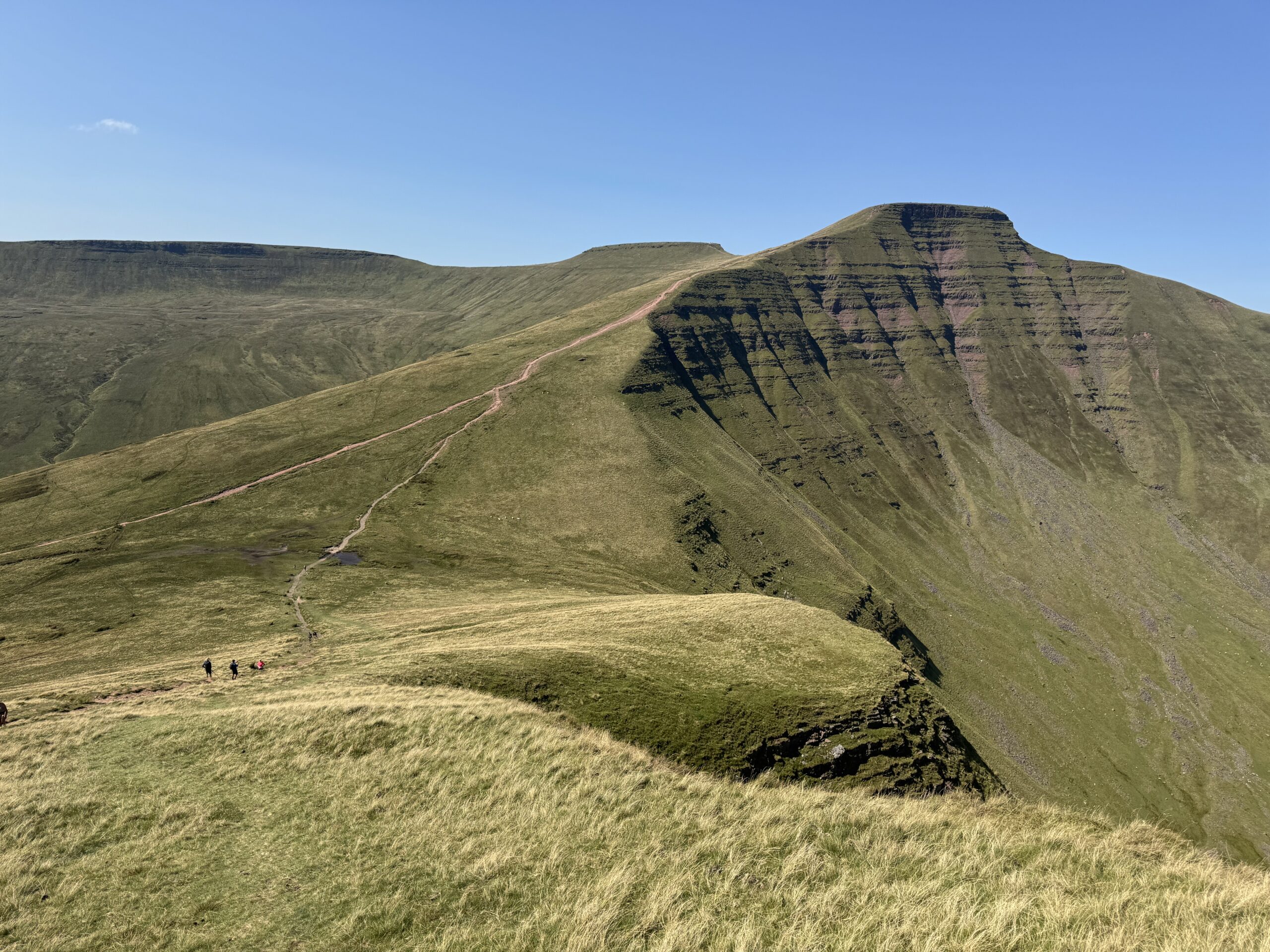
The most popular route starts from Pont ar Daf car park on the A470, south of Brecon. It is a well maintained path around 4.5 miles return with around 400 metres of ascent. On a clear February morning the light hitting the flat topped peak and its neighbour Corn Du at 873m is extraordinary. Pale, clean, almost Nordic in character. The views on a clear day stretch south across the valleys to the Bristol Channel and north deep into mid Wales.
Important practical note for 2026: The path between Pont ar Daf car park and Storey Arms, running parallel to the A470, is currently closed for forestry works. Check the National Trust website for the latest route information before visiting and plan your approach accordingly.
If you want to avoid the main tourist route entirely, the Cwm Gwdi approach from the north is quieter and arguably more scenic. It passes through a valley with strong military history. The remains of a Victorian army training camp are still visible among the trees before the path ascends to the ridge.
Whatever route you choose, always check the Mountain Weather Information Service (MWIS) forecast before heading up. Winter conditions on the summit can be severe and the path can be icy. Waterproofs, layers and good boots are non-negotiable.
The Canal: The Walk People Forget About
Not everyone wants to spend their time in Bannau Brycheiniog ascending mountains, and that is entirely reasonable.
The Monmouthshire and Brecon Canal is one of the most beautiful and underused walking routes in Wales. Opened in 1812, it runs for 42 miles from Brecon south to Newport, with the northern 35 miles navigable. The towpath is flat, traffic free and genuinely lovely, particularly the stretch immediately south of Brecon town where the canal winds through countryside with the mountains visible on either side.
In late February, with the trees still bare and the water high, it has a particular quality. Quiet and contemplative, with the sound of water and the occasional narrowboat chugging gently past. It is the antidote to the more dramatic experiences elsewhere in the park and perfect for families, those who prefer a gentler pace, or anyone who simply wants to walk and think.
Brecon town itself is worth exploring. Small, characterful and genuinely unpretentious, it has an excellent independent food and cafe scene and the Theatr Brycheiniog on the canal basin puts on a good programme throughout the year.
The Towns Worth Stopping In
Bannau Brycheiniog is not just mountains and waterfalls. The towns around the park are some of the most interesting in Wales.
Aberhonddu (Brecon) is the main hub. A small market town with a fine medieval cathedral, a good selection of independent shops and the canal right on its doorstep. It is relaxed and unpretentious with a genuine community feel rather than the tourist polish of some Welsh market towns.
Y Gelli Gandryll (Hay-on-Wye) on the eastern edge of the park is world famous for its bookshops. The town has more than two dozen independent bookshops including the enormous Richard Booth’s Bookshop with its own café and cinema. On a grey February afternoon, losing a few hours in Hay is an excellent use of anyone’s time.
Crug Hywel (Crickhowell) is the hidden gem. A small, handsome town on the River Usk with an excellent selection of independent restaurants and pubs, a medieval bridge and easy access to the eastern Beacons and the Black Mountains. It consistently features in lists of the best places to live in Wales and once you visit you will understand why.
Y Fenni (Abergavenny) is the food capital of Wales. It has a Saturday market that is exceptional and the surrounding countryside including the Blorenge and Sugar Loaf mountains offer some of the best hill walking in the area.
Stargazing: The Night-Time Reason to Stay Over
There is one very compelling reason to book a night rather than visit as a day trip: the dark skies.
Bannau Brycheiniog became an International Dark Sky Reserve in 2013, the fifth such designation in the world at the time. With minimal light pollution across most of the national park, on a clear night the sky is genuinely spectacular. The Milky Way is visible to the naked eye and the sheer density of stars is the kind of thing that makes people stop and look.
The best spots for stargazing include the National Park Visitor Centre at Libanus, Usk Reservoir and Llanthony Priory in the Black Mountains. The Brecon Beacons Observatory runs organised stargazing evenings and several accommodation providers offer dark sky packages with access to equipment and guided sessions.
Late February is an excellent time for this. The nights are long, temperatures are cold which means clearer skies, and the summer fog and haze that can reduce visibility has not yet arrived. Wrap up well.
Practical Information for Visiting in Late February
Getting there Bannau Brycheiniog is around 30 miles from Cardiff, roughly 45 minutes by car via the A470. From London it is under three hours on the M4. The nearest train stations are Merthyr Tydfil (12 miles from Pen y Fan) and Abergavenny (useful for the eastern Beacons). Bus services within the park are limited so a car gives you significantly more flexibility.
Parking The main National Trust car park at Pont ar Daf costs £7.50 per car and £10 per motorhome. Cwm Gwdi car park is £4 per car. Both car parks have electric vehicle charging points. There is no overnight parking.
What to wear Late February in the mountains means unpredictable conditions. Even if the valleys are mild, the summits can be cold, wet and windy. Pack waterproofs, warm layers, a hat and gloves and wear proper walking boots rather than trainers. Check the weather forecast specifically for the mountains as MWIS is the most reliable source.
Accommodation Late February is solidly off peak, which means prices are lower and availability is good. Options range from bunkhouses and farmhouse B&Bs to country house hotels and self catering cottages. Brecon and Crickhowell are the best bases for exploring the central and eastern park. For Waterfall Country, look at accommodation near Pontneddfechan or Ystradfellte.
Current path closures (February 2026) The path between Pont ar Daf car park and Storey Arms is currently closed for forestry works. Check the National Trust website at nationaltrust.org.uk for updates before your visit.
FAQ
When is the best time to visit Bannau Brycheiniog? Summer is popular for good reason but late February to early March offers a genuinely compelling alternative. Quieter, cheaper and with the waterfalls at their most impressive after winter rainfall. Autumn is also excellent for colour and atmosphere.
How do you pronounce Bannau Brycheiniog? Ban-eye Bruch-ay-nee-og. It translates roughly as “the Peaks of Brychan’s Kingdom.” The park officially adopted its Welsh name in 2023 though both names are widely used.
Is Pen y Fan hard to climb? The standard route from Pont ar Daf is around 4.5 miles return with roughly 400 metres of ascent. It is considered moderate and achievable for reasonably fit walkers of most ages, but not a casual stroll. In winter conditions it can be more challenging. Always check the weather forecast and wear appropriate kit.
Can I walk behind the waterfall at Sgwd yr Eira? Yes. The path behind Sgwd yr Eira is one of the most memorable walking experiences in Wales. The route is accessible year round but can be slippery in wet conditions so take care and wear boots with good grip. In late February it is at its most dramatic with the falls in full flow.
Is Bannau Brycheiniog good for families? Very. The waterfall walks can be adapted for different abilities, the Monmouthshire and Brecon Canal towpath is excellent for all ages and the National Showcaves Centre at Dan yr Ogof has a dinosaur park and underground caves that children love. The Brecon Mountain Railway runs heritage steam trains through the park and is a great option for younger visitors.
Do I need a car to visit? It is significantly easier with one. Train stations at Merthyr Tydfil and Abergavenny give access to parts of the park and some bus services operate during the summer, but the park is large and the most interesting areas are spread out. A car gives you the freedom to explore properly.
Where is the best place to stay? Brecon is the main hub and best central base. Crickhowell is excellent for the eastern Beacons and has a great food scene. For Waterfall Country, look for accommodation near Pontneddfechan or Ystradfellte. For stargazing, anywhere away from the A470 corridor with open south facing skies works well.
Is it free to visit the National Park? Visiting the park itself is free. There are parking charges at National Trust car parks, £7.50 per car at Pont ar Daf and £4 at Cwm Gwdi. The National Showcaves Centre, Penderyn Distillery and some guided experiences have entry fees.
What wildlife might I see in February? Late winter is a good time for birdwatching. Red kites are a regular sight soaring over the valleys, buzzards are common and the woodland around Waterfall Country supports a good variety of woodland birds. Welsh mountain ponies roam the open hillsides throughout the year. Otters inhabit the rivers but are rarely seen.
Is Bannau Brycheiniog a Dark Sky Reserve? Yes. It became an International Dark Sky Reserve in 2013, one of the first in the world. On a clear night away from the park’s small towns the stargazing is exceptional. February nights are long and cold which typically means clearer skies. The Brecon Beacons Observatory offers organised sessions.
Visiting Bannau Brycheiniog soon? We’d love to hear about it. Reply to the All in Wales newsletter or tag us on social media.
Also check out the Pen y Fan: A Complete Guide to Climbing Wales’ Highest Southern Peak
